Hansel and Gretel
— How sibling love and courage triumph over fear
Once upon a time, at the edge of a great, dark forest, there lived a poor woodcutter with his two children, Hansel and Gretel. Times were hard, and food was scarce. One night, the children overheard their stepmother telling their father that the family could no longer feed everyone — the children would have to be left in the forest.
Hansel crept outside and gathered smooth white pebbles, filling his pockets. The next day, as their parents led them deep into the woods, Hansel secretly dropped the pebbles one by one along the path.
That night, when their father did not return, Gretel began to cry. "Do not worry," Hansel said, squeezing her hand. "I have left us a trail. The moon will show us the way home." And sure enough, the white stones glimmered like tiny stars, and the children followed them safely back to their father's door.
Lost in the Woods
But hard times came again, and once more the children were led into the forest — this time deeper than before. Hansel had no pebbles this time, only a crust of bread, which he broke into crumbs and scattered behind him as they walked.
When night fell and their parents did not come back, Hansel and Gretel searched for the crumbs to guide them home. But every single one was gone — eaten by the birds of the forest.
"Gretel," Hansel said, trying to sound braver than he felt, "we must keep walking. We will find a way." Gretel took his hand tightly, and together they walked on through the darkness, refusing to let go of each other.
The Gingerbread House
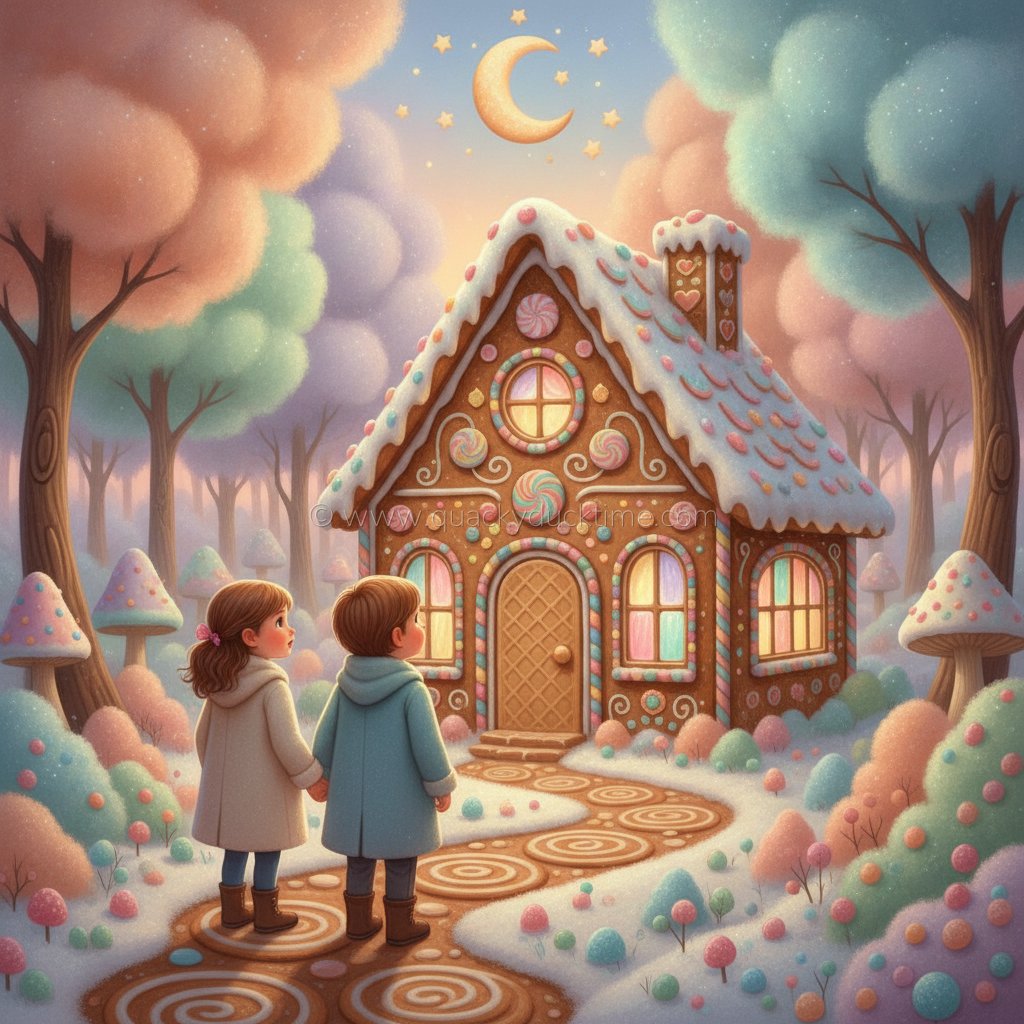
For three days the children wandered, hungry and afraid, until they came upon a strange and wonderful sight — a little house with walls made of gingerbread, a roof made of cake, and windows made of clear spun sugar.
Starving, the children began to break off pieces and eat. Suddenly, a soft voice called from inside:
"Nibble, nibble, little mouse, who is nibbling at my house?"
The door opened, and an old woman stepped out, leaning on a cane. "Come in, dear children," she said kindly. "You must be tired and hungry. I have soft beds and warm food waiting." Not knowing what else to do, Hansel and Gretel followed her inside.
But the old woman was not what she seemed. She was a wicked witch who had built the candy house to lure children to her — for she loved nothing more than to eat them.
Bravery in the Dark
The next morning, Gretel woke to find Hansel locked inside a cage. The witch cackled with delight, for she planned to fatten him up before cooking him for a feast. Each day, she demanded Hansel poke his finger through the bars so she could check if he was plump enough yet.
Clever Hansel, refusing to give up hope, held out an old bone instead of his finger. The witch, whose eyes were weak, felt the bone and grew impatient that he stayed so thin.
At last, the witch grew tired of waiting. She ordered Gretel to check if the oven was hot enough for baking. But Gretel, brave and quick-thinking, said, "I don't know how — will you show me?"
When the witch leaned forward to look inside the oven herself, Gretel gathered every ounce of her courage. With a mighty push, she shoved the witch straight into the oven and slammed the door shut. The wicked witch was gone for good.
Gretel rushed to free her brother, and the two children searched the witch's house, where they found chests overflowing with pearls and jewels. Filling their pockets, they set off through the forest once more — this time finding their way home at last, where their father, who had missed them terribly, welcomed them with open arms.
Hansel and Gretel had faced hunger, fear, and a terrible witch — but because they stood by each other and never lost their courage, they found their way through the darkest forest and back home again.
Attribution: Adapted from The Brothers Grimm, Kinder- und Hausmärchen (1812) — public domain.