
The Boy Who Cried Wolf
— A lonely shepherd boy's inner journey toward valuing truth
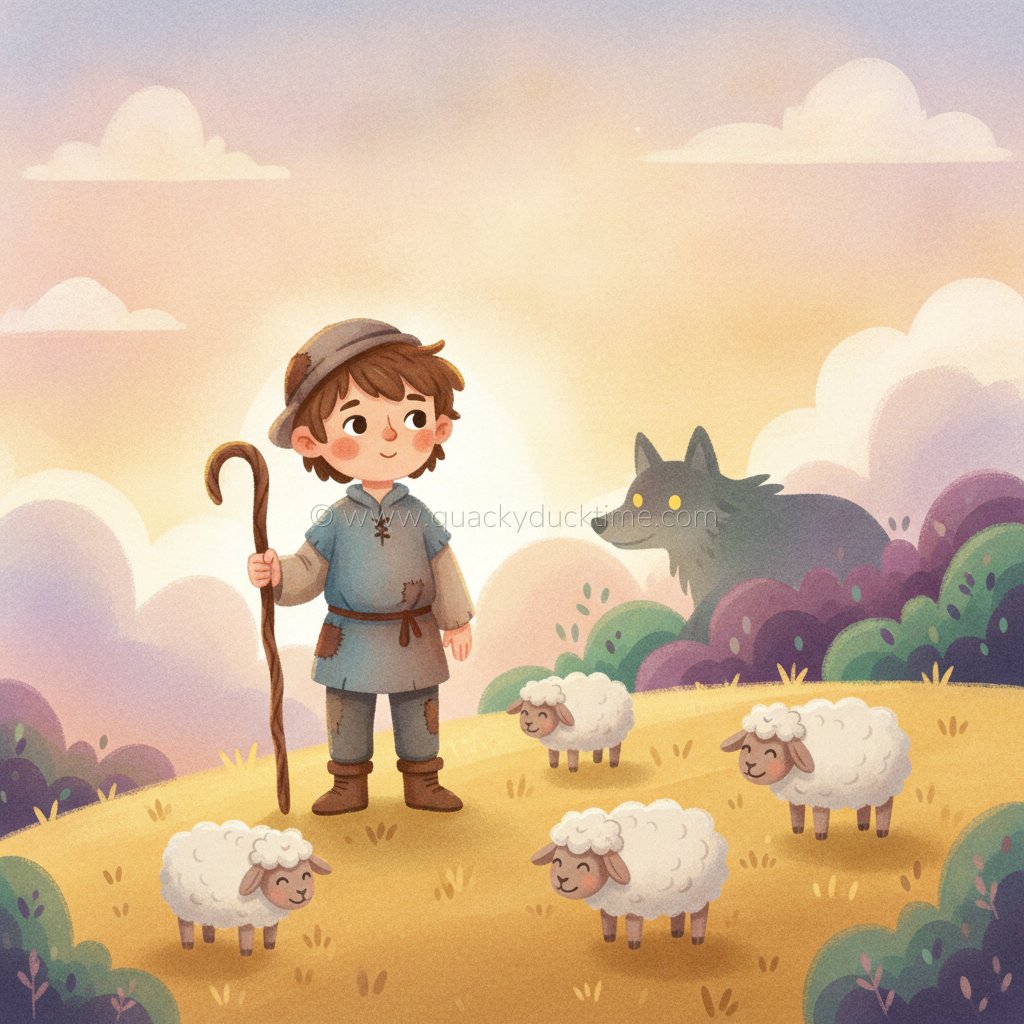
Long ago, in a quiet green valley, there lived a young shepherd boy whose job was to watch over a flock of fluffy white sheep. Every morning, he led them up a grassy hillside to graze, and every evening, he brought them safely back down to the village.
It was a peaceful life, but oh — it was a lonely one. The boy spent long hours with no one to talk to but the sheep, who only ever answered with soft, sleepy bleats. He watched clouds drift by. He counted blades of grass. He wished, more than anything, for a little excitement.
A Mischievous Idea
One warm afternoon, as the sheep munched lazily on clover, a thought popped into the boy's head — a thought that made his heart beat a little faster with excitement. He jumped up, cupped his hands around his mouth, and shouted down toward the village as loud as he could:
"Wolf! Wolf! A wolf is chasing the sheep! Help!"
Down in the village, farmers dropped their baskets and tools. They grabbed sticks and ran up the hill as fast as their legs could carry them, hearts pounding, ready to protect the flock.
But when they reached the top, breathless and worried, all they found was the boy, sitting calmly among his sheep — grinning from ear to ear.
"There's no wolf," he laughed. "I just wanted some company!"
The villagers were not amused. They shook their heads and walked back down the long hill, muttering to one another. But the boy didn't feel sorry at all. In fact, he felt rather pleased with himself. For a little while, he hadn't been lonely — he'd had a whole crowd of people rushing to see him.
A Second Trick
A few days later, the loneliness crept back in, heavier than before. So the boy tried his trick again.
"Wolf! Wolf!" he cried, waving his arms.
Once more, the villagers came running — and once more, they found nothing but a smiling boy and a peaceful flock of sheep.
"You mustn't fool us like this," one farmer said sternly, wiping sweat from his brow. "If you keep calling wolf when there isn't one, how will we know when there truly is?"
The boy shrugged. He didn't quite understand what the farmer meant — not yet. He didn't see that every time he shouted a lie, he was quietly stretching something invisible between himself and the village: their trust in his word. And trust, once stretched too far, doesn't simply snap back into place.
When the Wolf Was Real
Then, on a quiet evening when the sky was turning orange and the shadows grew long across the hillside, the boy heard something that made every hair on his arms stand up — a low, rumbling growl from behind a thicket of bushes.
His breath caught. This was no game. A real wolf, gray and hungry-eyed, was creeping toward the flock.
The boy's heart pounded as he scrambled to his feet. "Wolf! Wolf!" he screamed, and this time his voice trembled with real fear. "Please, somebody, help! It's really here!"
But down in the village, the farmers just sighed and shook their heads over their supper. "That boy and his tricks again," one muttered, not even looking up.
No one came.
The boy stood alone on the hillside as the wolf drew closer, and in that frightened moment, he understood something he hadn't understood before — not through scolding, but through his own pounding heart. Being honest wasn't just a rule grown-ups made up. It was the thread that connected him to everyone else — the thing that made people willing to run up a hill for him when he truly needed them.
He never wanted to feel this alone again — truly alone, with no one believing his voice.
Moral: Even when you're lonely or bored, telling the truth is what keeps you safe and connected to the people who care about you. Honesty isn't just about being good — it's about being someone others can believe in when it matters most.
Attribution: Adapted from Aesop's Fables (circa 6th century BCE) — public domain.